Interactive comp benchmarks

A members-only compensation benchmark for a community of 1,100+ senior operators.

See it live ↗
+100submissions in the first 24 hours
2×our average member applications that day
1,100+senior operators with access

Operators Guild’s annual comp survey used to end in a PDF. I rebuilt it as a live tool members sign into, filter down to their own title, stage, region, company size, and sector, and add their own numbers to. It launched in November 2026 and gets more specific with every response.

Why we built it

Comp data is only useful if it mirrors your actual situation. A median for “VP Finance” doesn’t tell you much when you’re at a Series B in Austin and that number is being carried by public companies in New York. Getting that granular in a static report is close to impossible — you’d need a version for every combination of title, stage, region, company size, and sector, and most of those cuts would be too thin to publish on their own.

So we built something members can filter down to exactly what they need. Comp is also moving quickly right now, and a once-a-year PDF can’t track that. Submissions are anonymous, but keeping the tool members-only means the data comes from a population we know: senior operators, not open internet responses.

What I built

I replaced the static report with a live benchmarks page that gets better as members add their numbers.

I’m not an engineer. I built it by directing Claude Code, ran security review and QA through Codex, and worked out the design in ChatGPT.
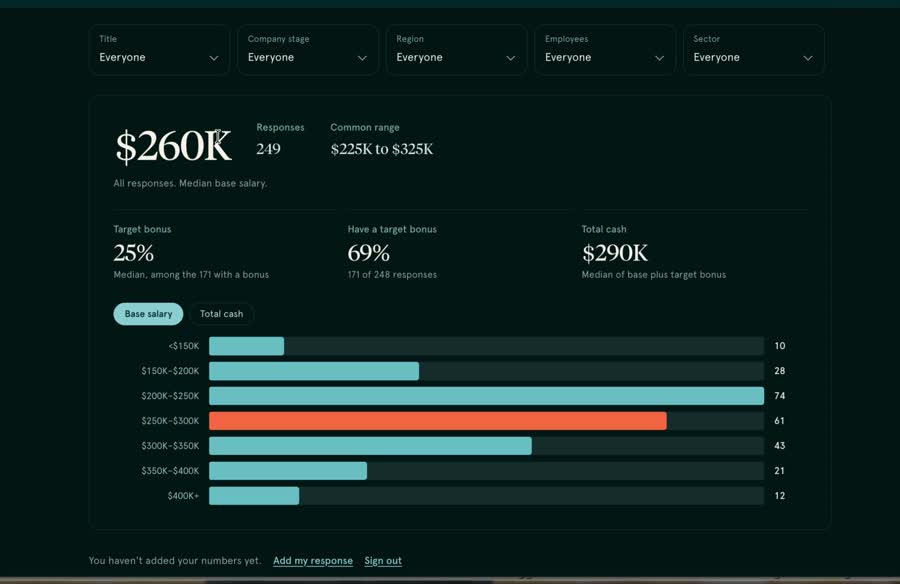
Here’s the member view, and what each part of it does.

How it works

Tap a number on the screen to see what it does.

1

The member view of the benchmarks tool: five filters across the top, a $260K median base salary from 249 responses, a common range of $225K to $325K, target bonus and total cash figures, and a bar chart of the salary distribution with the viewer’s own band highlighted.

Three ways in

What you see depends on who you are.

Anyone

Headline numbers are public: the median base salary, the common range, a breakdown by title, and a “where do you land” tool where you type in a salary and see roughly where it falls. Nothing you type there is saved.

Members

Members sign in with a one-time emailed link, checked against their membership status in HubSpot. They’re invited to add their own numbers, which takes about a minute and can be skipped. Once they’re in, they can filter by title, company stage, region, company size, and sector.

Non-members

A PDF snapshot sits behind an email gate. Every download is tracked in HubSpot under its own lead source, so marketing can follow up.

A 48-second walkthrough of the member view: signing in, adding your numbers, and filtering down to your own title, stage, region, size, and sector.

How the data stays clean

Responses are stored with a scrambled code, never a name or email, and they live in a separate system from membership records. A figure only shows publicly once 10 responses back it, or 5 in the member view, and we never show minimums, maximums, or anyone’s individual answer. Members can update their numbers whenever they want, and their older answers drop out of the totals instead of getting counted twice. Non-USD salaries convert at submission, so international responses count alongside everyone else’s.

10responses before a figure shows publicly
5responses before it shows in the member view
0names, emails, minimums, or individual answers shown

The stack

HubSpotMembership checks, lead tracking
AirtableResponses
ResendSign-in emails
Vercel + GitHubHosting and deploys

It sits on its own subdomain next to the Webflow marketing site and matches it in design.

What it took

I migrated 150 survey responses into the new data model, grouping free-text answers into consistent categories without storing the original text. The design took a few rounds of side-by-side options before it sat right next to the rest of OG’s brand. Before launch I ran an independent code review using Codex, which caught and closed privacy and security gaps, and then the team tested everything with clearly marked data that we cleared out before going live. Our CEO and leadership approved it with no changes.

See it live ↗